This week we have been asked to change an artefact of our choice into a new artefact based on one or more ideation techniques. I struggled to think of something to use at first but I find that listening to music helps me come up with ideas. Ritter and Ferguson’s (2017, p.8) results show that listening to happy music helps with creative thinking. After listening to some music I got the idea to use a short horror story. I enjoy reading these on Reddit every so often so I had a look and found this story really interesting: https://www.reddit.com/r/shortscarystories/comments/2ejsjg/seeing_red_the_first_day_of_school/. This is a little out of my comfort zone as I haven’t done much writing before but I do want to explore story based games throughout the course.
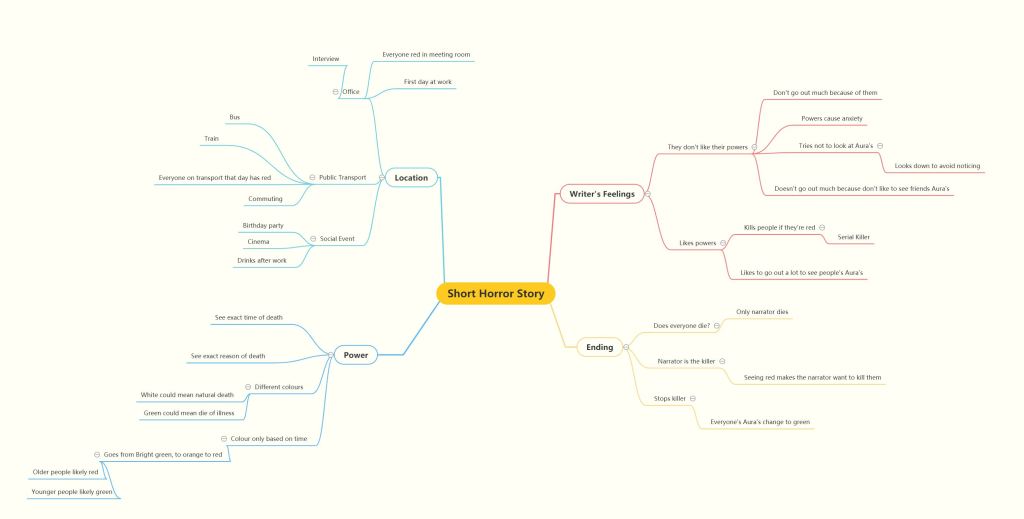
After looking through the ideation techniques, I decided to use a mind map. I have used these in the past and I’ve found them to be very helpful. I broke it down into 4 categories;
- Location
- Writer’s Feelings
- Power
- Ending
I thought changing the location from the school would be a good idea, I had some ideas such as office at work and social event such as a birthday party. The current writer’s feelings are that they like seeing these aura’s but I thought it would be interesting if they hated their powers. I had some ideas on the powers themselves such as showing the exact date of death and reason of death. I thought the ending could also be changed, for example, if the writer is the killer themselves.
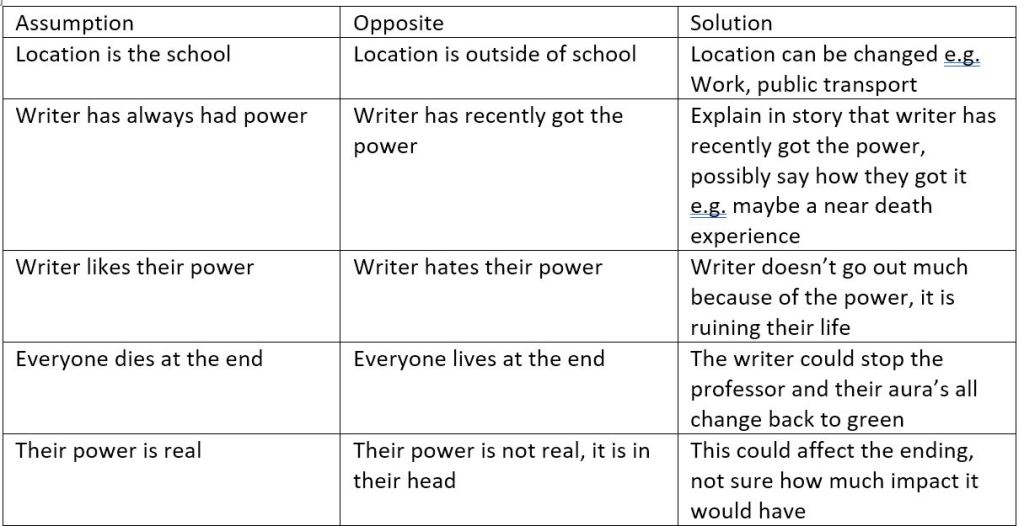
I also chose to try opposite thinking as I thought it would be a fun activity. This reinforced the ideas I had in the mind map and there were some new ideas such as getting the power by a near death experience.
Overall I am happy I went out of my comfort zone and I enjoyed coming up with new possibilies for the story. I had a lot of other ideas so I could have created a few more versions, for example, the writer could be on the way to work and notice that everyone on the train has a red aura.
Mind Map;
Opposite Thinking
Updated Story
I am going to my best friend’s birthday party. I hate going to social events. I used to like it, catching up with friends, having fun, meeting new people. It used to be a good break to the dreary depressions of everyday reality.
You see, I have recently acquired a sort of power. I barely survived a car accident and died for 1 minute, ever since, when I look at people, I can sense an aura around them which tells me when they’re going to die. It shows green when someone has a long time left but it shows red when someone is going to die very soon. I am afraid to look at people most of the time, I tend to look at the floor, but I can’t get out of it tonight. What if he has a red aura? Do I tell him? Would he even want to know? He’d think I’m crazy!
I arrived at the venue late, and reluctantly looked up to find my friend. A sea of red. My friend noticed me standing in the doorway, and came over, “hey, I didn’t think you were going to make it!”. I stared at him blankly, too stunned to say anything. I ran to the bathroom and poured water over my face. Looking up I catch my reflection in the mirror. I see red. I run out of the bathroom and see a bright green aura walking into the building, they lock the door.
Reflection
This week was quite tough for me. I struggled to think of what to use to start with but with the aid of music it helped my thought process, this has taught me to listen to more music when my ideas are blocked. I also went far out of my comfort zone by writing a short story, I don’t think I’ve written anything like this since I was at school, over 10 years ago. I think overall it came out well, I’m happy with the result but I can’t help but think I could have done more. My career goals include creating my own game one day and I plan on having a story in it so I think it’s important to explore this side of things throughout the course. I find that a good story can make me fall in love with a game.
References
Ritter, S. and Ferguson, S., 2017. Happy creativity: Listening to happy music facilitates divergent thinking. PLOS ONE, 12(9), p.e0182210.
 Richard Charles Ellis